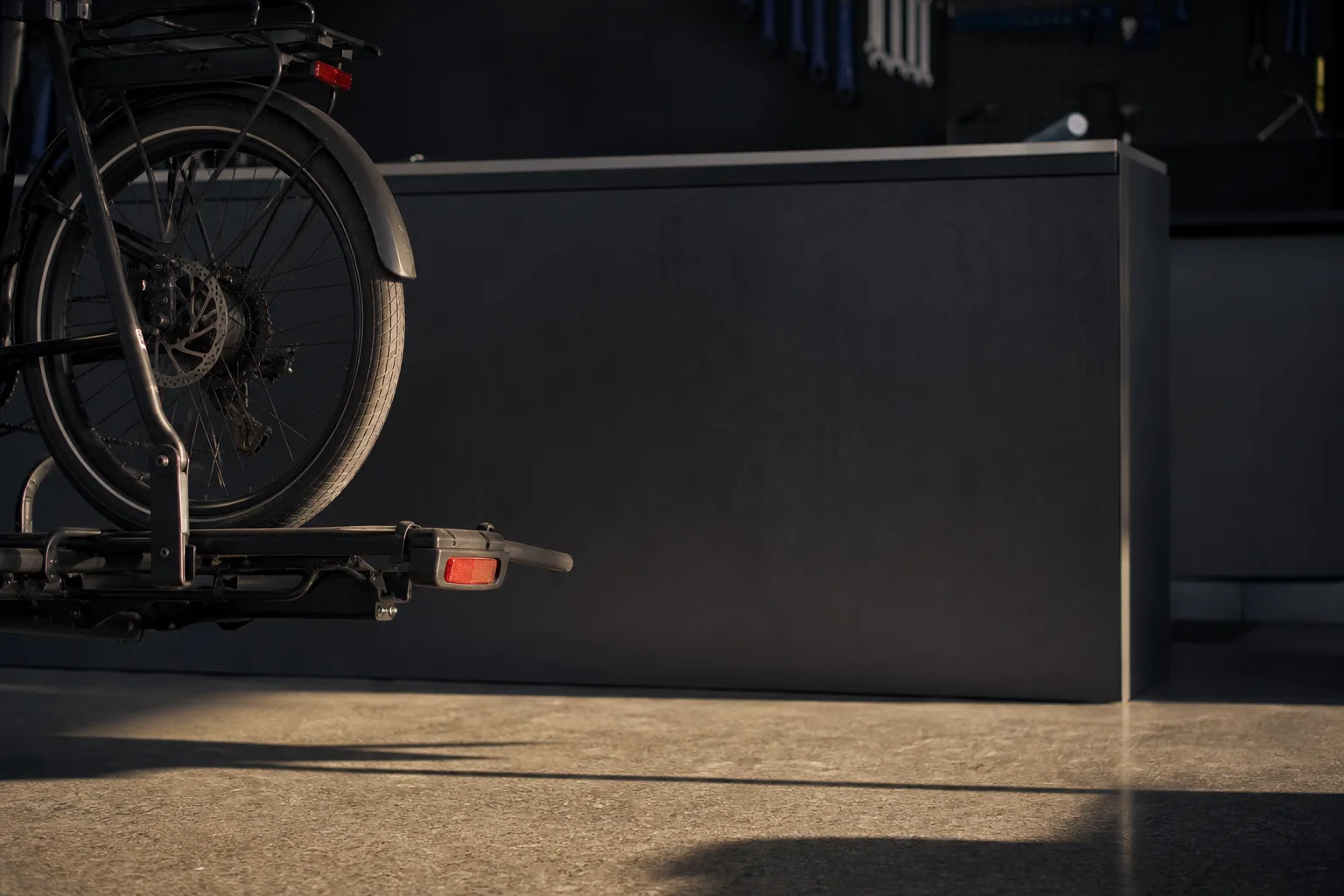
A weight figure on a spec sheet turns into five separate physical problems once the bike is yours, and each one can be checked before you buy.
A weight figure printed on a spec sheet is a single number, but it arrives in your life as five separate problems, each one showing up on a different day and in a different posture. Fifty-five pounds is not heavy on flat ground with the tires inflated and the motor helping. It is heavy at shoulder height, heavy at the end of a driveway with one hand on a rack arm, and heavy when it is upside down on gravel with a rear wheel that has a motor built into it. What a careful reader checks, before the money moves, is each of those five moments separately.
One: the lift onto a hitch rack, measured in inches, not pounds
The question is not whether you can pick up fifty-five pounds. It is whether you can hold it steady at the height the rack tray sits, which on most hitch racks is somewhere between knee and mid-thigh, with the bike swinging on its own axis while you aim a wheel into a channel. Go find a rack in a parking lot and look at where the tray actually lands. Then check whether the model you want has a ramp option, because a ramp turns a lift into a push, and a push is a different body altogether. Racks rated for e-bike weight per tray exist; the rating is printed, and it is worth reading.
Two: whether the battery comes out, and how it behaves once it does
Pulling the battery off before the lift can take somewhere between six and ten pounds out of the equation, which is often the difference between an awkward lift and an impossible one. Check three things at the shop, not from the website. Does the pack slide out cleanly with the bike upright, or does it need the frame tipped. Is there a real handle molded into it, or a lip you pinch with fingertips. Does the key have to stay in the lock while you carry it, which means one hand is now busy. Integrated packs that hide inside the down tube look better and sometimes come out harder.
Three: charging where the bike actually lives
If the bike sleeps in a shed, a detached garage, or at the bottom of basement stairs, the outlet situation decides whether you ever charge it consistently. A removable battery lets you carry the pack indoors and charge it on a kitchen counter, in sight, which many people prefer anyway. The Consumer Product Safety Commission is the federal agency responsible for e-bike and lithium battery safety in consumer products, and its guidance on charging practice is worth reading once before you settle on a storage spot. Check the charger cord length, check whether the port faces a wall when the bike is parked, and check that you can reach the port without kneeling.
Four: the flat rear tire on a road shoulder
A rear hub motor means the motor is inside the rear wheel, and that wheel carries a power cable that has to be disconnected or worked around before the wheel comes off. On some bikes there is a plug connector right at the axle, easy to unclip. On others the cable runs into the frame and the whole job becomes a shop job. Ask to see the connector before you buy. Ask whether the wheel uses a thru axle or nuts, and what size wrench. Tire liners, sealant, and a puncture-resistant tire bought up front cost far less than the tow.
Five: what the shop counter charges for a system it does not stock
Labor on a proprietary drive system, meaning a motor and controller sold only by that one brand, is priced differently than labor on a chain and a derailleur. Diagnostic time gets billed. Parts may have to be ordered from a single distributor, and the bike sits in the back while that happens. Before buying, call two local shops and ask a plain question: do you service this brand, and what is your hourly rate for electrical work. A shop that says no is telling you something useful about the next three years of ownership.
Weight is not the enemy. Weight in the wrong posture, at the wrong height, at the wrong moment is the enemy, and every one of those moments can be rehearsed in a parking lot before a dollar changes hands.